
H-LYZER APPLICATIONGreen hydrogen that follows the power market
The cheapest electrolyser to run is not the one that runs all year. The H-Lyzer is designed to make hydrogen in the hours when renewable power is cheapest, and to stop, start and ramp as often as the market requires.
WHY FLEXIBILITY PAYSFirm power is expensive. Flexibility is valuable.
Modelled for western Denmark, northern Germany and Spain, a dedicated wind, solar and gas plant would supply firm, round-the-clock power for €102-128/MWh.
From October 2023 to September 2026, the grid's cheapest 4,000 hours in the same markets cost €26-55/MWh, including grid fees, taxes and levies. Each of the seven bidding zones analysed had between about 220 and 940 hours a year at or below €0/MWh.
That changes the question from "how many hours can the electrolyser run?" to "which hours should it run?"
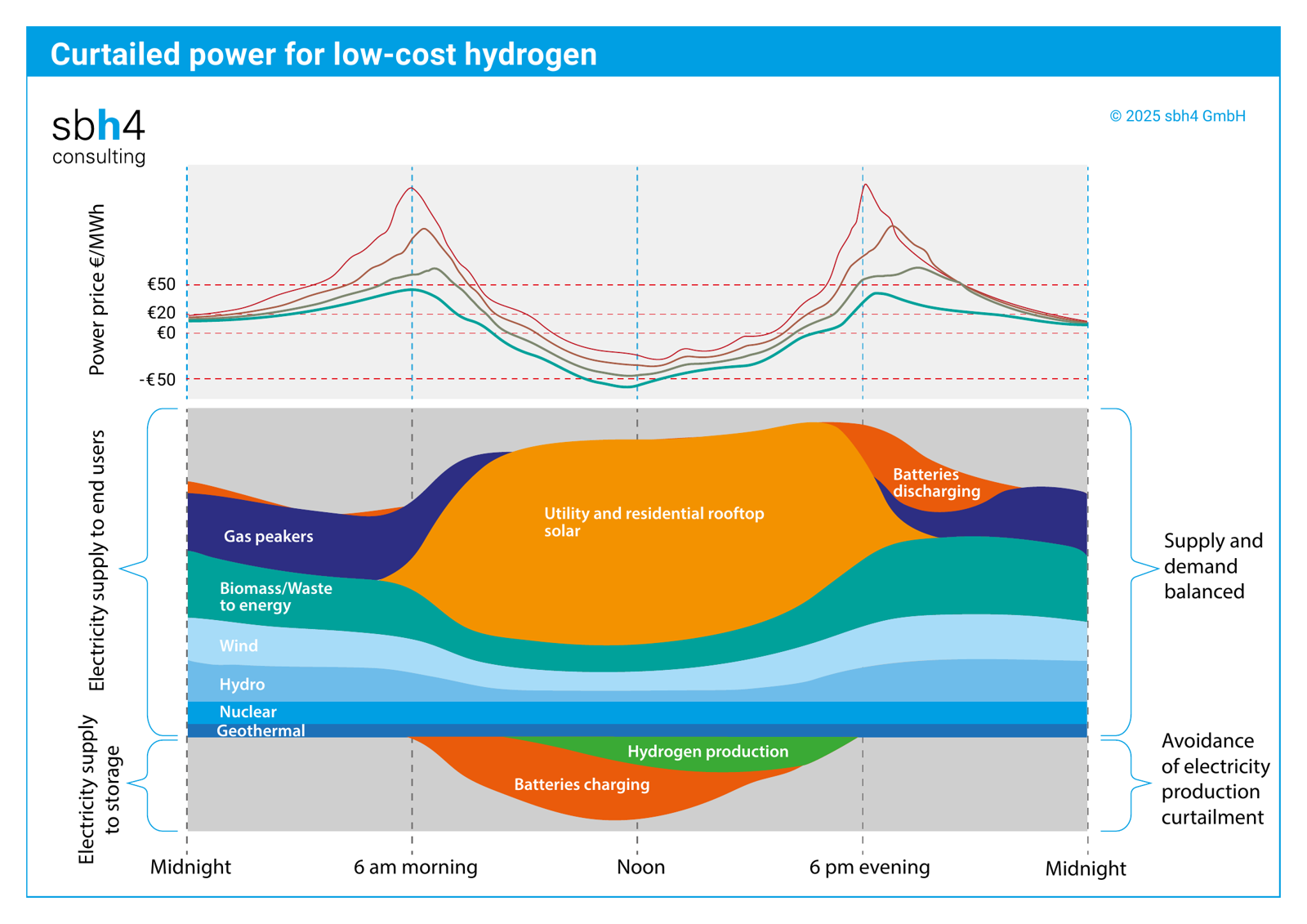
Curtailed power for low-cost hydrogen.© 2025 sbh4 GmbH.
THE OPTIMUM IS NOT 8,760 HOURSRun in the cheapest hours, without a cost penalty
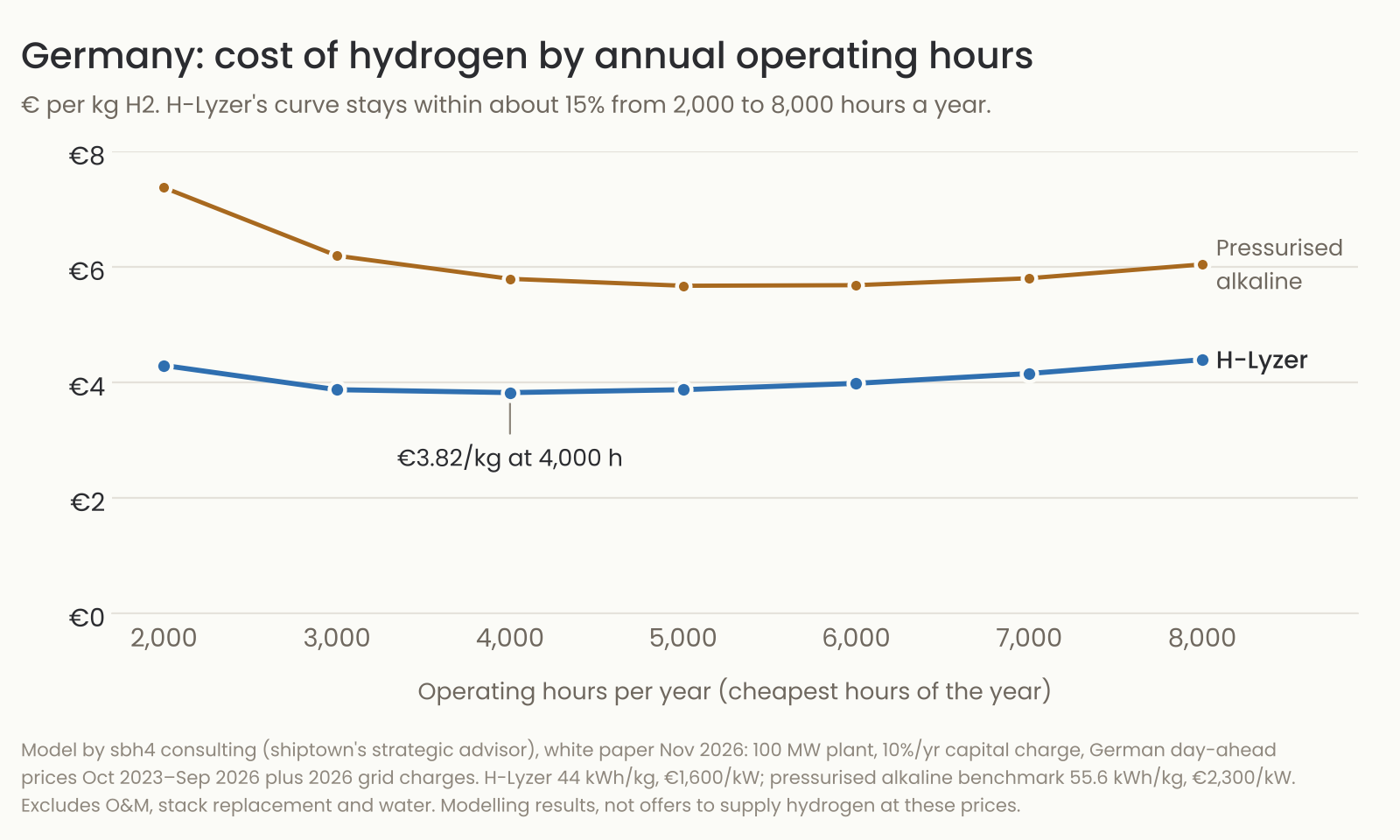
In Germany, the H-Lyzer's modelled cost of hydrogen stays within about 15% between 2,000 and 8,000 operating hours a year, with its lowest point, €3.82/kg, at about 4,000 hours.
Low capex makes lower utilisation affordable. High efficiency cuts the electricity bill in every operating hour. Flexible operation then concentrates production on the cheapest acceptable hours. The three effects reinforce each other.
SEVEN EUROPEAN POWER MARKETSLow cost of hydrogen across Europe
Each system at its own cost-optimal operating hours, the H-Lyzer's modelled cost of hydrogen is €0.94-1.95/kg lower than a pressurised alkaline benchmark. The advantage is largest where power prices are volatile, as in Germany and Denmark.
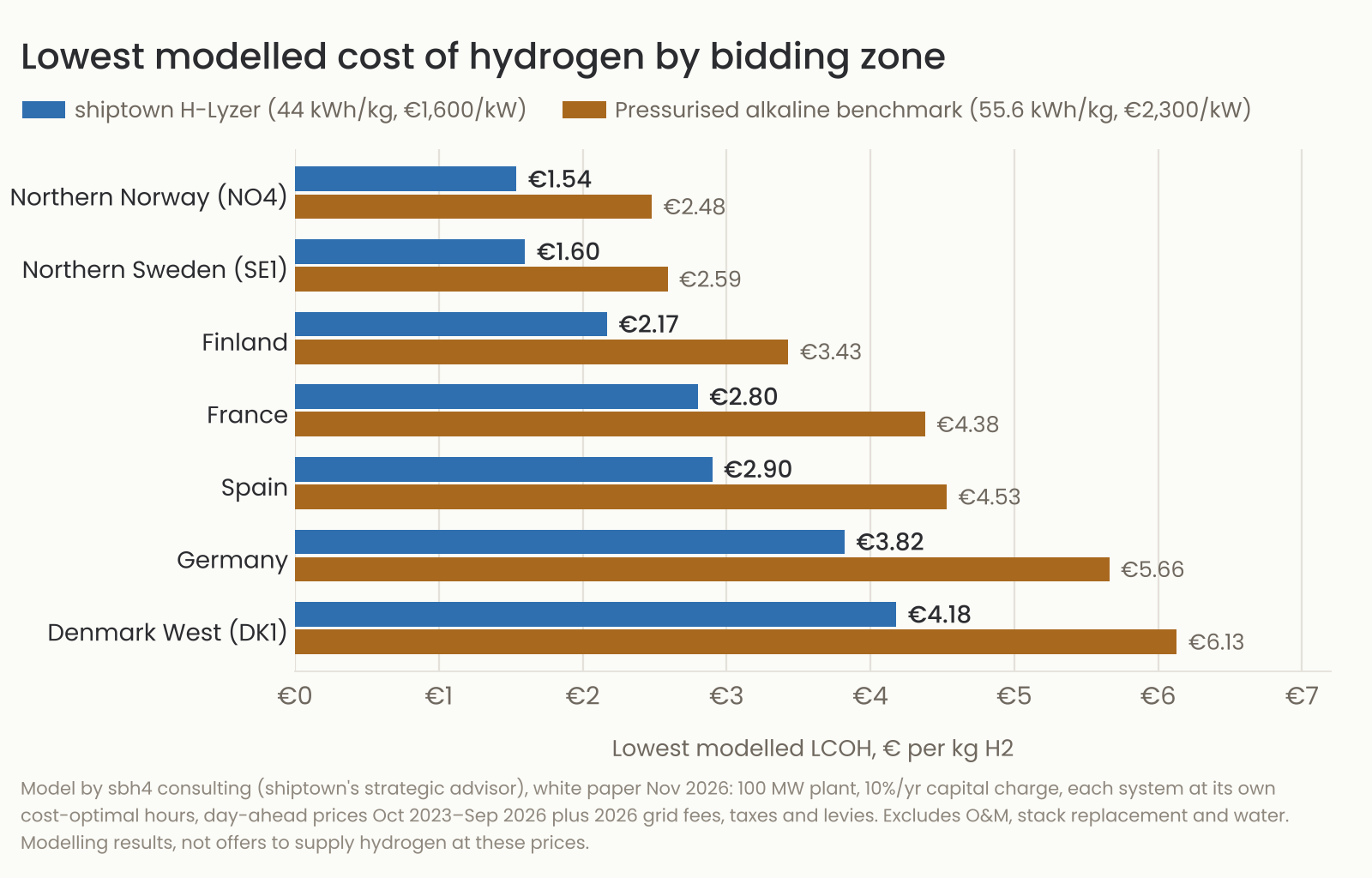
Modelled by sbh4 consulting, shiptown's strategic advisor (white paper, November 2026). These are modelling results that depend on location, power not tos purchasing, grid charges, financing and equipment performance. They are not offers to supply hydrogen at these prices.
who is it forOne solution. Clear value for every stakeholder.
Green hydrogen project developers
Modelled cost of hydrogen €0.94- 1.95/kg below a pressurised alkaline benchmark in all seven European markets analysed
A flat cost curve lets the plant follow the market without a cost penalty
About 26% more hydrogen from the same grid connection than a 55.6 kWh/kg system
Utilities, TSOs and grid operators
Full electrical ramp in under 10 seconds
Tolerates instantaneous loss of power
Could provide grid-balancing and frequency services where local rules allow
Absorbs surplus renewable output that would otherwise be curtailed
Electrolyser buyers and industrial hydrogen users
Hydrogen at 35 bar(g) and >99.9% purity without a compressor
Hot-swappable stacks for uninterrupted supply '
Less balance of plant: no cooling water and no inter-stage compressor cooling
Hot and humid sites
No cooling water required
Total water use at or below state-ofthe-art electrolysers
No external heat needed during ramp-up or operation
RFNBO hydrogen projects
Designed for hourly matching with renewable power from 2030
Low-price hours count as timematched automatically
Fewer batteries needed between renewables and the electrolyser
Not sure where your project fits?
RFNBO RULESMade for hourly matching
Under the EU's rules for renewable fuels of non-biological origin (Delegated Regulation (EU) 2023/1184), hydrogen production must be time-matched with renewable electricity: monthly until the end of 2029 and hourly from 2030.
Any hour in which the day-ahead price is at or below €20/MWh, or below 0.36 times the EU ETS allowance price, counts as matched. Those are often exactly the hours a flexible electrolyser prefers to run.
The European Commission announced a targeted review of these rules in 2026. Check the rules in force for your project.
WORKED EXAMPLEA 100 MW H-Lyzer plant in Germany
Germany is among the dearest of the seven markets modelled, but it has large, policy-backed demand for hydrogen.
2,273
kg/h
Hydrogen output at full load, at 44 kWh/kg
9,091
t/yr
Running the cheapest 4,000 hours of the year
€3.82
/kg
Modelled cost of hydrogen at 4,000 hours
sbh4 consulting white paper (November 2026): €1,600/kW fully installed, 10%/yr capital charge, German day-ahead prices October 2023-September 2026 plus 2026 grid charges and today's exemptions for new electrolysers. Excludes O&M, stack replacement and water.
Planning a hydrogen project?
Tell us about your site, power supply and offtake. We will share technical information and our development timeline.